Tuesday, March 2, 2010

Research- Sacred Trees


Sacred TreesIt is mentioned of the Kalpavriksha and Chaityavriksha in the ancient scriptures indicating that the worship of the tree is indeed an ancient Indian practice. The Ancient Aryans worshiped nature. Plants, Trees and the other elements were always revered and several rituals were connected to them. Tree worship continues to be an element of modern Indian traditions. There are many trees which are considered Sacred. Some of the Sacred Trees are as follows :

Ashoka TreeAshoka Tree
The Ashoka Tree is one of the most sacred and legendary trees of India, and one of the most fascinating flowers in the Indian range of flower essences. The beautiful, perfumed flowers of the Ashoka Tree are used in temple decoration. Prized for its beautiful foliage and flowers, the Asoka Tree has many religious significances. This tree is revered by the Hindus, Buddhists and Jains. It is said that Lord Buddha was born under this tree in Lumbini. Some says that Lord Mahavira renounced the world under the Ashoka tree in Vaishali. The Hindus worship this tree because it is dedicated to "Kama Deva" (God of Love). The Ashoka tree gets a mention in the epic Ramayana as the "Ashoka Vatika"(garden of Ashoka trees) where Hanuman first meets Sita. Literally meaning "the "sorrowless tree", it is believed that drinking the water in which the flowers have been washed is widely considered a protection against grief among the Indians.

BanyanBanyan
Like the Peepal Tree, the Banyan Tree also symbolizes the Trimurti-Lord Vishnu, Lord Shiva and Lord Brahma. The tree also symbolizes life andfertility in many Hindu cultures. That is the reason, banyan tree is worshiped by those who are childless and this tree should never be cut. The tree can grow into a giant tree covering several hectares. The Great Banyan in the Indian Botanic Garden, Howrah, is considered to be the largest tree in the world. Lord Dakshinamurthy, who is worshiped as the "ultimate guru", is usually depicted beneath a banyan tree. He symbolizes Lord Shiva and is seen as the the destroyer of ignorance and embodiment of knowledge.

Bael TreeBael Tree
In India, Bael tree is considered to be very sacred because it is associated with Lord Shiva. It is said that Lord Shiva is pleased by offerings of leaves from the Bael Tree, also known as bilva or bel tree. Thus, the Brahmanas worshiped Lord Shiva by for a period of one fortnight by offering bel leaves and that way satisfied Lord Shiva greatly. The fruit, flowers and leaves of the tree are all sacred to Shiva. Planting these trees around home or temple is sanctifying and is equivalent to worshiping a Linga with bilva leaves and water. The trifoliate leaf or tripatra of the bael tree is believed to symbolize the three functions of the Lord-the creation, preservation and destruction as well as his three eyes. The offering of the leaves is a compulsory ritual while worshipping Lord Shiva all over India. The Beal tree is also sacred to the Jains. It is said the 23rd Tirthankara, Bhagwan Parasnathji attained "Nirvana" enlightenment under a Bael tree. Besides religious significane, almost all parts of the tree have medicinal qualities Bael is an ingredient in many Ayurvedic and Siddha formulations.

BambooBamboo
The common names of Lord Krishna-Venugopal, Bansilal, Murali and Muralidhar reflect His association with Bansuri or Venu, His constant companion. Bansuri is actually a flute made of bamboo. That is the reason, bamboo is revered in India because it is associated with Lord Krishna.

BananaBanana
Though banana is not a tree but it is considered a tree because of its structure and size. It is a very sacred tree and all parts of the tree are used for some purpose or the other. For example, the trunk of banana is used to erect welcoming gates. The leaves are used to make the ceremonial pavilion. In some pooja, the leaves are used to serve "prashad". Just as leaves of bel tree are customarily offered to Lord Siva, it is believed that offering of the leaves of banana pleases Lord Ganesa. Banana as a fruit is offered to Lord Vishnu and Laksmi. Infact, the eleventh day of the bright half of Pausa (December-January) is considered to be very auspicious to offer banana to Lord Vishnu and Goddess Laxmi and sixth day of the bright fortnight of Kartika (October-November) is considered auspicious to offer banana to the Sun god. In some regions, banana tree is worshipped while performing Kadali Vrata or fast. According to tradition, during Vaisakha, Magha or Kartika sukla caturdasi, a banana tree is planted and nurtured till it bears fruit. It is said that worshiping the tree with flowers, fruit, etc. will help in the welfare of one's family.

Bhang Tree
To all Hindus, the Bhang Tree is a very Holy Tree. There are many beliefs associated with the Bhang Tree. It is believed that a guardian lives in the Bhang leaf. To see in a dream the plant or water or leaves of Bhang is considered lucky as it brings wealth and prosperity into the dreamer's power. To meet someone carrying Bhang is a sure sign of success. Bhang is a popular drink made of the leaves and flowers of the Bhang tree and considered to be a "prashad". It is must for every devotees to have bhang on Mahashivratri. It is also said that nothing good can come to the man who treads underfoot the holy Bhang leaf. A longing for Bhang is a sign of happiness. Since ancient times, Yogis take deep draughts of Bhang so that they can center their thoughts on the Eternal without any disturbance because bhang has that intoxicating power in it. Infact, the students of ancient scriptures at Benares are given Bhang before they sit to study. Bhang has also many medicinal virtues. It is also believed that no god or man is as good as the religious drinker of Bhang. It is also said that to restrict the use of such a holy and gracious herb as the hemp or Bhang would cause widespread suffering and annoyance.

CoconutCoconut
In Sanskrit, the name for the coconut palm "Kalpa vriksha", which means"the tree which provides all the necessities of life" or "wish-fulfilling tree". The coconut tree is given a special place in most Hindu households and great care is taken to nature the tree. In the southern part of India, it is a must for every household to plant coconut trees. There is a popular saying, "Water the plant for five years, reap coconuts for life" . The coconut is used for all religious purposes. Infact, it represents the main "sthapana" of any pooja. The whole pot filled with water, mango leaves and coconut, also known as "Purnakumbha" is a symbol of Goddess Laksmi or Fortune and the coconut represents divine consciousness. To break a coconut in the beginning of any event is considered to be very auspicious. Coconuts are offered in Temples to worship to various Gods and Goddesses. The fruit is also believed to represent Lord Shiva and the three black marks on the coconut shell, symbolizes his eyes.

LotusLotus
The Lotus is always considered as an evocative symbol of beauty, purity and divinity and a highly revered flower by all Hindus. In Hinduism many of the deities are pictured sitting upon a lotus or holding a lotus flower. Rising up pure and unsullied from the depths of the muddy swamp, the lotus represents the manifestation of God. The pure white lotus flower is the only plant to fruit and flower simultaneously. The flower is a symbol of Goddess Laxmi. One of the incarnations of the Mother-Goddess or Devi and wife of the Hindu god Vishnu, Laxmi is the goddess of fortune and prosperity as well as the epitome of feminine beauty. According to Hindu mythology she was born radiant and fully grown from the churning of the sea. Lakshmi is always portrayed as sitting on a lotus flower which is her traditional symbol. That is why this flower held in high esteem. The Lotus flower has also symbolized spiritual enlightenment. It is said that the Lotus in Eastern Culture has a similar symbolism to the Rose in Christianity.

MangoMango
The mango tree is another sacred tree of the Hindus. The significance of this finds mention in the Ramayana, Mahabharata and the Puranas. The mango as a fruit is a symbol of love and fertility. The leaf of the tree is used during most religious and social ceremonies of the Hindus. A"Purnakumbha" is a pot filled with water and topped with fresh mango leaves and a coconut and considered to be the "staphna" of the puja. The pot symbolizes Mother Earth, water is the life giver, coconut the divine consciousness and the mango leaves symbolizes life. The whole "Purnakumbha" is symbolizes Goddess Lakshmi and good fortune. On various auspicious occasions, mango leaves are used to adorn entrances at home to signify good fortune. Mango blossoms are used on Basant Panchami day in the worship of Goddess Saraswasti. The tree is also sacred to the Buddhists because it is believed that Lord Buddha performed during his lifetime the instantaneous creation of a large mango tree from the seed at a place called Shravasti.

NeemNeem
It is said that on the first day of Chaitra, after Amavasya, it is very essential to worship the neem and eat its leaves, mixed with pepper and sugar, as a safeguard from fever. The neem tree besides having various medicinal benefits is a highly revered tree among the Hindus because it is a manifestation of "Goddess Durga" or "Maa Kali". That is why the tree is sometimes referred to as Neemari Devi. The Tree is worshiped very intensely. Tamil Ladies, while worshiping Maa kali dress in red, carry branches of the Neem tree, and dance in public places swishing the branches as an act of exorcism and to purify the world. The multi-headed occult goddess Yellamma (a highly revered goddess in south Indiai) sometimes assumes the appearance of a young neem tree. Young maidens worship this Goddess by cladding themselves all over in neem branches. In Bengal, neem is considered to be the tree which is the abode of "Sitala" (the great Pox-mother who can cause or cure disease). The customary treatment of pox is therefore to rub the body with neem leaves while making prayers to Sitala. It is also said that the smoke of burning neem protects both the living and the dead from evil spirits.

PeepalPeepal
The Peepal Tree also known as "Ashvattha" in Sanskrit, is a very large tree and the first-known depicted tree in India. A seal discovered at Mohenjodaro, one of the cities of the Indus Valley Civilisation depicts the peepal being worshiped. According to the Brahma Purana and thePadma Purana, when the demons defeated the gods, Lord Vishnu hid himself in the Peepal Tree and that is why it is believed that the Peepal Tree is a symbol of Vishnu and is worshiped since a long period of time. There is another belief that the tree represents the Trimurti-the roots being Brahma, the trunk Vishnu and the leaves Shiva. Some says that Lord Krishna is believed to have died under this tree, after which the present Kali Yuga started. According to another belief, Goddess Lakshmi also inhabited the tree, specially on Saturday and hence it is considered auspicious to worship it. Infact women worship the tree to bless them with a son tying red thread or red cloth around its trunk or on its branches. According to the Skanda Purana, to cut down a peepal tree is considered a sin. Even Buddha is believed to have attained enlightenment under the peepal tree and the peepal is also sacred to Buddhist. Hence it is also called the Bodhi tree or "tree of enlightenment".

Sandalwood TreeRed Sandalwood Tree
Besides being used in fragrance industry, fine woodworking and aromatherapy, Sandalwood is commonly used for incense and religious ceremonies. The Red Sandalwood Tree is considered to be a very sacred tree and is like a sage among many people. It is said that all other trees are considered ordinary trees and are like ignorant men in front of a Red Sandal wood. Popularly known as Chandan, Sandalwood has an extraordinary fragrance. Sandalwood paste is used in all religious rituals. The paste is smeared on the foreheads of devotees of Vishnu and Shiva and it is said that the sandalwood paste is meant to cool and protect the "Agnachakra" present between the eyebrows. In India, the death pyre is made using sandalwood branches for centuries. According to legend, Lord Ganesha was created by Goddess Parvati out of sandalwood paste that she used for her bath and breathed life into the figure. According to Indian mythology, sandalwood tree is depicted as being entwined with serpents. Sandalwood remains cool and aromatic even when the poisonous serpent coils around it. This also has another meaning that the basic nature of an individual cannot change because of outer effects.

TulsiTulsi
Tulsi is always associated with purity and a highly revered and used for all religious purposes among the Hindus. It is considered very auspicious to have a Tulsi plant in the front courtyard of many Hindu households. Tulsi beads can always be seen around the necks of serious yogis and mystics in India, worn to purifying the mind, emotions and body. Dispelling the unwanted influences of others, gross and subtle, is one of the many benefits bestowed by Tulsi plant and hence worshipped by all. Tulsi plants are also prized in Ayurveda, where they are considered an integral part of that sophisticated healing system. In practically every temple in India, no puja can be started without few Tulsi leaves. There is always a special place reserved for this sacred plant. The qualities and amazing powers of this plant are found throughout the oldest writings on Earth, the Sanskrit Vedas of ancient India, where it is stated that simply touching the wood is purifying at many levels. Tulsi plant is most loved by Lord Vishnu and Vrinda Devi, the Goddess ruling Tulsi is known as the personification of bhakti or devotion to the Supreme Being.

Monday, March 1, 2010

Khoya Chapter One- Draft One


They were young. And they were Lost.
Some stories about other worlds begin with 'Once upon a time', others with 'In the beginning'. 
In this world the beginning is not known.
This World, sometimes forgotten and sometimes vaguely remembered by the Children and elders as 'Khoya': What was lost.
The elders in khoya tell tales of 'What-once-was'. A feeble whisper of the past. They spoke of a world not constructed and constrained. A world devoid of tall glass buildings. They spoke of other beings and half beings made of as fluid as water and as light as breath they called 'spirit'. They spoke of these spirits and life that existed beyond experiments in laboratories. They spoke of 'Colour': Strange hues and tones and pigments that spread like honey. They spoke of other life with four legs: creatures with a will of their own. Winged Creatures that would soar into the far reaches of space and dance with stars with painted wings and sing songs that told stories of other lands.
To the children of Khoya the words 'Of-their-own' seemed unimaginable. As did words like 'spirit', 'soul' and 'nature'.
To the children of Khoya this was myth. A jumble of fantastical mumbo-jumbo jumbled up in the elders' memories. And soon no one listened to those tales either. 
There was no room for fantasy here. Only routine. And magic disrupted routine.
And what's the point of a story if it isn't even real? They said.

However, if one is to try and rediscover 'What-once-was'
If one is to attempt to pinpoint when Khoya was lost- it was possibly when the glass sphere was built around the earth.
Before, when the world was a spirit of itself, at first man lived in Harmony with other spirit (because he was intouch with his own).
He saw the network of light. He spoke the language of love, a language without words but only truth.
Everyday on earth was a celebration of this love. And man's voice (strong and sweet then) was part of this great cosmic orchestra.
They would sing in crystal voices about this love. they would spin round and round with the stars. Whirling in ecstacy. Everything was magical.
And I don't mean the mumbo-jumbo sort of magic. I mean Bliss.
one day men and women were distracted while singing. While looking up at the skies and his heart was connected to this great network when suddenly his eye caught something flying glimmering.
It was a firefly. 
'Light that is worn by something apart from the stars' he thought...the idea of having light was interesting to him and he thought about it for days on end.
He wanted it. And then on, when he sang with the orchestra, it wasn't a celebration of love. It was a song of longing.

Having always lived by his need- this 'want' was new and exciting to him. 
7 days and 7 nights later he saw Fire again. One day when all the world creatures were asleep, he snuck up behind the firefly and trapped it in a small glass box.
He labelled this box and it gave him great pleasure that he could see it whenever he wished and it would never ever go away (it had no choice).
Soon he collected more creatures like this. He no longer sang in praise with the rest but instead arranged his collection meticulously in rows.
When the other spirits approached him to ask him why he didn't sing and why he was trapping these creatures and plants he said
'Don't you see? I discovered them and so they are mine'
The spirits didn't understand this logic at all.
But the truth is- that before any pandora's box was opened...it was first sealed up.
and this incessant want to label and claim ownership over was called greed.

Man's greed led him to try and manipulate. Try and consume and control the spirit of the earth.
He was blind when he saw not the sadness in that he killed. He was deaf was he heard not the cries of the earth.
But above all, he was intoxicated.He was addicted to power. and it is this addiction, this intoxication and this blindness that gave birth to a dark powerful force with a life of its own
'The Nasha'
It started as a small puff of smoke that enveloped his heart and wrapped its long vines around it. This gave him indifference.
It then spread to his chest that swelled up as his lungs were taken over by the Nasha. This gave him pride.
Next it spread to his throat and wound its vines around his neck nearly choking him. This gave him cold silence.
Then to his eyes. dilated pupils. Nasha swirling inside like dark pools of sorrow. This gave him blindness.
and having wrapped itself around every nerve and entered every stream that ran through man's body:
finally it penetrated his mind. This brought him death.
And not death of the spirit (for the spirit lives forever) or death of Love (because love exists beyond that) but the death of his compassion.
Which is the worst end of all.
The spirits were chased out one by one. Poisonous gases were released into the world that punched holes into the layers of spirit and protection that enveloped the earth like a blanket.
Homes were destroyed. Forests burnt down. The sky began to fall, the earth began to quake. Spirit fought back. The sky would cry for days flooding the earth. His greed to control spirit brought terror. His greed to possess and consume land brought wars. And soon it wasn't even land anymore. Soon it was Oil, then Water. and last but most tragically- The Battles of Breath. 
With holes in his sky, with a hole where a heart once existed, surrounded by chaos and cacophony- he had to make a choice- 
Either he embraced the spirit and restored it to a magnificence of its own- let go of his control and need to consume and lived in Harmony.
Or
He built more walls and banished the spirit forever.
And Ofcourse, He chose to banish. 
So he created a glass globe around the earth to block out the clouds that became animals in the sky. He shut out the stars that looked down upon the earth like eyes.
He created large concrete bottlestoppers that stopped rivers from flowing. He scooped out all the multitudes of fish and life in the ocean and replaced it with plastic that he'd consumed and spat out.
Remember poor Hansel and Gretel?
Who got lost in their woods and other kingdoms of love we could find no more: miniature labyrinths we no longer find our way back into. 
The world faded,diminished and disintegrated into smaller and smaller histories until finally becoming the one we know.
Like a crystal prism that had been preserved for centuries to unleash the rainbow that shattered into tiny fragments .Cold, brittle and weak empires of manmade catastrophy eroded the soul like dirt off cliffs that drift in winds into beautiful tragedies of 'What-once-Was'. 
Children were lined up in rows of gray and with glassy eyes of conformity gazing upon nothing. A vacant expression branded upon their faces with no decipherable features or beauty or ugliness. Their mind's trained not to think, not to question. This is the age of mediocrity and these voices of a forgotten generation of zombies.  Jaded and incomplete but told to feel otherwise, these Children are laid to rest in an adult tone with the once beating heart of a child. 
This was Khoya. A mistake. A generation of alienation. And where our story begins.

Feedback-
There are two different thing happening. there's the story and then my opinion. It's getting toooooo rambly, the styles of writing change and I'm getting angsty with my opinion.
Crisp-Clear and yet poetic. 


Tuesday, February 23, 2010

character archetypes

stolen from Nalishas blog http://averylittleland.blogspot.com/
wanted to see how many characters I had :D
The prophet of doom- yes
floating skull-no
the devil- Not reallllly
The ringmaster- yes
dancing bear- uhhhhhh
freaks- YES 
giant cat- ehh...i could add that in. :\
birdman- yes
the lovers- possibly
The queen-possibly (in one sense)
the giant- yes :)
the apparition- yes
the hero- Yes (heroine)
The pirate- n o
the fairy- MANY!
The guards- yes
the golem - huh/
the headless man- no
the faithful hound- maybe
the nurse-no 
the monkey0 no
the minataur- no
the old man0 yes
the messenger-yes
the lunatic- yes
the witches- yes
the talking shrub- yes
the snake- yes
the broken man- yes
the twins-no

Ohhhhhhhhh there are too many archetypes :D

Timeline and Notes- 23rd Feb 2010- Chapter 1


Timeline- Click it for details

Monday, February 22, 2010

Atut- the rocks


The Rock Clan
known as 'Atut' (meaning unmovable/unbreakable in Hindi)
are the oldest creatures in Khoya.They’ve been here for millions of years.
Inherently still in nature, it is this very stillness that makes them excellent keepers of   wisdom.
 “Written in Stone”, they record the history of the universe. They are keen observers though their greatest sense is that of sensing movement and the sounds of the earth. They do not record by sight or meaning of the sound. By sensing the vibrations of the earth (because of their inherent stillness). this history is recorded not in the form of words but wave patterns...that change as they sense and record more. This process is wrongly called ‘weathering’ when infact it is just a manifestation of their internal recordings of 'what has been'.
Curious-reserved-silent and Still. Slow moving.

The following scientific experiment is inspiration to how patterns are made in the heads of the 'Atut'
sensing vibrations.
(the experiment is rather trippy as well)


Book Design and different Binding Techniques


Sunday, February 21, 2010

Sketches


References for the Khoya box


Sunday, February 14, 2010

Sunday Morning with Maya

Maya Raghavan is 9 years old and she studies in Aditi International School.
She has two brothers and sisters 
Charlie- Who's 5
and Molly who's 7
Some of her favourite books are Harry potter and Alice in Wonderland
She wants to be a writer or an artist when she grows up.
\


Monday, February 8, 2010

it all makes sense now


“The goal of life is to make your heartbeat match the beat of the universe,
to match your nature with Nature.”


~Joseph Campbell


This is what it would look like


only less romantic and with a laptop infront of you.

The Earth Laughs in Flowers

Seed of Life

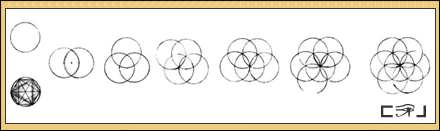
The Seed of Life is a symbol for the seven days of creation.
The first step was the creation of the Octahedron. The next step was to spin the shape on its axes. In this way a sphere is formed (see diagram 7). Bear in mind that the creator's consciousness exists within the Sphere, and the only thing that really exists is the membrane of the sphere itself.

  seed of life

The next thing the creator's consciousness did was to go to the outside surface of the sphere, (the old testament refers to "the spirit of the Creator floating upon the face of the waters") and creating another using the same process of creating an octahedron and turning it into a sphere. By creating the second sphere the Almighty actually created light. In projecting another converted octahedron into a sphere on the surface of the first sphere, you will get the image of two circles crossing each other in their centers, a shape known as Vesica Pisces (diagram 7a). This pattern is a geometrical formula which represents the electromagnetic spectrum of light (for further information how this can be done, check out Drunvalo Melchizedek's book "The Ancient Secret of The Flower of Life Vol.2") and the first thing that God created was light - "Let there be light".

Seed of life

In continuing to duplicate the spheres and creating further Vesica Pisces you will see many aspects of creation driven out of the geometrical structures, emerging out from the vortex motion by this continuous creation of more Vesica Pisces. The continuation of the creation process can be seen in diagrams 7b to 7f.
Diagram 7b being day two of the creation.
Diagram 7c being day three of the creation.
Diagram 7d being day four of the creation.
Diagram 7e being day five of the creation.
Diagram 7f being day six of the creation.

Note that here the seven day creation process ends. The Seed of Life is fully formed on the "SHABBAT", the day of rest. The first vortex is completed and the seed which contains the blue print of the universe is fully formed.

Flower of Life

The akashic records (akasha is a Sanskrit word meaning "sky", "space" or "aether") is a term used in theosophy (and Anthroposophy) to describe a compendium of mysticalknowledge encoded in a non-physical plane of existence. These records are described to contain all knowledge of human experience and the history of the cosmos. They are metaphorically described as a library and other analogues commonly found in discourse on the subject include a "universal computer" and the "Mind of God". Descriptions of the records assert that they are constantly updated and that they can be accessed through astral projection. The concept originated in the theosophical movements of the 19th century, and remains prevalent in New Age discourse.

considered by some to be a symbol of sacred geometry, said to contain ancient, religious value depicting the fundamental forms of space and time.[1][2][3][4] In this sense, it is a visual expression of the connections life weaves through all sentient beings, believed to contain a type of Akashic Record of basic information of all living things.[


http://en.wikipedia.org/wiki/Flower_of_Life
In Scripture, the Tree of Life in the Garden of Eden represents the original quality of love and wisdom that was flourishing within the humanpsychoscape (one’s inner reality) when it was in perfect innocence and harmony with God’s divine order and spiritual principles.

Quotes about Seeds


Since the seed does not contain anything other than the seed, even the flowers and the fruits are of the same nature as the seed: the substance of the seed is the substance of subsequent effects, too. Even so, the homogenous mass of cosmic consciousness does not give rise to anything other than what it is in essence. When this truth is realized, duality ceases.

- Yoga Vasishtha

A tree starts as a seed. When conditions are right, the seed sends its root into the ground. The seed contains the entire concept or “blueprint” for the future tree. Its growth literally involves taking elements from mineral world and reconstituting various molecules into a higher-level structure or bio-complexity. The seed’s operation can be said to raise-up and exalt the mineral kingdom. This process becomes more refined as the developing tree produces branches, leaves, flowers, and fruit, resulting in the creation of new seeds.

Symbolism- Trees and Seeds


Myths and Symbolism of Trees
I


Every one of these symbols is an embodied idea—combining the conception of the Divine Invisible with the earthly and visible.
—H. P. Blavatsky
What is a symbol? A symbol must be contained in the idea or ideas that it is intended to represent, writes Mr. Judge. A symbol of the house could never be a boat or a wing of a bird, but "it must be an actual part chosen to represent or stand for the whole." The word "symbol" is derived from the Greek word meaning "to throw with" or "to throw together." A symbol is a visible representation of an idea. "To be a just and correct symbol, it should be such that the moment it is seen by one versed in symbolism, its meaning and application become easily apparent." (The Heart Doctrine, p. 149)
Every symbol must have a deeper meaning besides the obvious one. In fact, H.P.B. observes that each symbol has at least seven keys to its interpretation—physical, astrological, geometrical, metaphysical, psychological, allegorical, cosmological, etc.
What does a tree symbolize to us? Sangharakshita, a Buddhist teacher, narrates that while taking a walk with a Nepalese friend in Kalimpong, they came across a magnificent pine tree with a smooth trunk and the mass of deep green foliage. He could not help exclaiming: "Isn't that a beautiful tree!" The Nepalese friend replied, "Oh yes, it is a beautiful tree. There's enough firewood there for the whole winter." Sangharakshita remarks, "He did not see the tree at all. All he saw was a certain quantity of firewood" (Vision and Transformation, p. 137). This shows that each one of us sees a thing from his/her own perspective, which is, mostly, materialistic, superficial, and utilitarian. We see plants and trees all around us and our day-to-day experience shows that some of these trees provide food, shelter, flowers, medicines, wood, etc. But are we ever aware of any deeper significance? Now and then, some poets intuitively grasp and convey the symbolic aspect of the trees.
In the poem, "No More!", Alfred Tennyson, a great lover of nature, writes of a wild weed flower, growing all alone by the banks of a brook:
Oh, sad no more! Oh, sweet No more!
Oh, strange, No more!...
Surely all pleasant things had gone before,
Low buried fathom deep beneath with thee, NO MORE!
Like this flower, the present state of any of us is only a part of the total existence. There is an immortal aspect or Ego clothed in the present form, but the present form has arisen from, has behind it and is backed by, past experiences—good and bad, pleasant and unpleasant—of which we have little or no memory. A large and essential nature of each one of us remains hidden. Both man and universe have their roots in eternity. There is immanence of God in the infinitesimal atom and the vast system. This is well brought out by Tennyson in his little poem:
Flower in the crannied wall,
I pluck you out of the crannies,
I hold you here, root and all, in my hand,
Little flower—but if I could understand
What you are, root and all, and all in all,
I should know what God and man is.
We observe that the life cycle of a tree begins with a seed that gives rise to a tree, a flower and a fruit, which in turn gives back the seed. A universe comes into existence and goes out of existence, periodically. Just as a seed gives rise to a new tree and has within it the entire tree, potentially, so also, on dissolution, the universe is held as solution in suspension in space—in the Laya centre—like the salt dissolved in water, which crystallizes on heating. This Laya centre is like a seed from which a new universe comes into existence at the dawn of every Manvantara—period of activity—and its energies are drawn back into the Laya centre at the time of dissolution orpralaya. Similar is the case with humanity. Manu represents humanity. There are 14 Manus in every Kalpa. root and a seed Manu appear at the beginning and the termination of the human period on any particular planet. Seed-Manu—appearing at the close of a period of activity—represents the fruition of humanity and carries the seed for future humanity, i.e., the seeds for the human races of the forthcoming Round. (S.D., II, 307-8)
The life cycle of the tree symbolizes the Law of Karma: "As you sow, so shall you reap." Thus:
"A harsh word uttered in past lives, is not destroyed but ever comes again." The pepper plant will not give birth to roses, nor the sweet jessamine's silver star to thorn or thistle turn. (The Voice of the Silence, p. 37)
But the causes of our actions, like the seeds of a tree, remain hidden, always making us wonder, "What did we do to deserve such a fate"? Sir Edwin Arnold expresses it thus in The Light of Asia:
That which ye sow ye reap. See yonder fields!
The sesamum was sesamum, the corn
Was corn. The Silence and the Darkness knew!
So is a man's fate born.
Every form in our universe is a reflection of something existing in the invisible world. Plato called it an archetypal world that contains ideas or paradigms of all forms on our plane. Every form that we see is an embodied idea. Plato considered lower types (forms) to be concrete images of higher, abstract images. The meaning and the mission of any object in nature can be understood only when we are able to understand the higher abstraction which it ensouls, and of which it is a representative and a symbol on earth. (Studies in "The Secret Doctrine," Book II, p. 55)
There are certain plants and trees that were specifically used as symbols to convey some deep truths. For instance, the Lotus plant is a very ancient symbol for both Kosmos and man. The Lotus plant grows up through the water, having its roots in the mud, and spreading its flower in the air above. "The root of Lotus sunk in the mud, represents material life, the stalk passing up through the water typifies existence in the astral world, and the flower floating on the water and opening to the sky is emblematical of spiritual being." The Lotus flower represents the abstract and concrete universe and symbolizes the dual creative power in Nature. It is said that the seeds of the Lotus (and of all phanerogamus plants) contain, even before they germinate, perfectly formed leaves and miniature shape of what one day as perfected plants they will become. "This typifies the fact that the spiritual prototypes of all things exist in the immaterial world before those things materialized on Earth" (S.D., I, 57-8). Even before the objective universe comes into existence, the ideal or abstract forms or prototypes of all objective things exist in the archetypal world.
Similar to the Lotus plant, there is a special significance attached to the Ashwattha tree, the Banyan tree and many more. Thus:
From the highest antiquity trees were connected with the gods and mystical forces in nature. Every nation had its sacred tree, with its peculiar characteristics and attributes based on natural, and also occasionally on occult properties, as expounded in the esoteric teachings. Thus the peepul or Âshvattha of India, the abode of Pitris (elementals in fact) of a lower order, became the Bo-tree orficus religiosa of the Buddhists the world over, since Gautama Buddha reached the highest knowledge and Nirvâna under such a tree. The ash tree, Yggdrasil, is the world-tree of the Norsemen or Scandinavians. The banyan tree is the symbol of spirit and matter, descending to the earth, striking root, and then re-ascending heavenward again...The sycamore was the Tree of Life in Egypt, and also in Assyria. It was sacred to Hathor at Heliopolis; and is now sacred in the same place to the Virgin Mary. Its juice was precious by virtue of its occult powers, as the Soma is with Brahmans, and Haoma with the Parsis. "The fruit and sap of the Tree of Life bestow immortality." A large volume might be written upon these sacred trees of antiquity, the reverence for some of which has survived to this day, without exhausting the subject. (The Theosophical Glossary)

Sunday, February 7, 2010

References-book formats

pixies