Sunday, February 14, 2010

Sunday Morning with Maya

Maya Raghavan is 9 years old and she studies in Aditi International School.
She has two brothers and sisters 
Charlie- Who's 5
and Molly who's 7
Some of her favourite books are Harry potter and Alice in Wonderland
She wants to be a writer or an artist when she grows up.
\


Monday, February 8, 2010

it all makes sense now


“The goal of life is to make your heartbeat match the beat of the universe,
to match your nature with Nature.”


~Joseph Campbell


This is what it would look like


only less romantic and with a laptop infront of you.

The Earth Laughs in Flowers

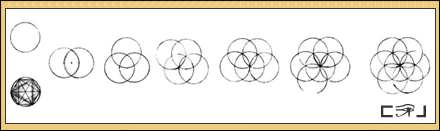
Seed of Life

The Seed of Life is a symbol for the seven days of creation.
The first step was the creation of the Octahedron. The next step was to spin the shape on its axes. In this way a sphere is formed (see diagram 7). Bear in mind that the creator's consciousness exists within the Sphere, and the only thing that really exists is the membrane of the sphere itself.

  seed of life

The next thing the creator's consciousness did was to go to the outside surface of the sphere, (the old testament refers to "the spirit of the Creator floating upon the face of the waters") and creating another using the same process of creating an octahedron and turning it into a sphere. By creating the second sphere the Almighty actually created light. In projecting another converted octahedron into a sphere on the surface of the first sphere, you will get the image of two circles crossing each other in their centers, a shape known as Vesica Pisces (diagram 7a). This pattern is a geometrical formula which represents the electromagnetic spectrum of light (for further information how this can be done, check out Drunvalo Melchizedek's book "The Ancient Secret of The Flower of Life Vol.2") and the first thing that God created was light - "Let there be light".

Seed of life

In continuing to duplicate the spheres and creating further Vesica Pisces you will see many aspects of creation driven out of the geometrical structures, emerging out from the vortex motion by this continuous creation of more Vesica Pisces. The continuation of the creation process can be seen in diagrams 7b to 7f.
Diagram 7b being day two of the creation.
Diagram 7c being day three of the creation.
Diagram 7d being day four of the creation.
Diagram 7e being day five of the creation.
Diagram 7f being day six of the creation.

Note that here the seven day creation process ends. The Seed of Life is fully formed on the "SHABBAT", the day of rest. The first vortex is completed and the seed which contains the blue print of the universe is fully formed.

Flower of Life

The akashic records (akasha is a Sanskrit word meaning "sky", "space" or "aether") is a term used in theosophy (and Anthroposophy) to describe a compendium of mysticalknowledge encoded in a non-physical plane of existence. These records are described to contain all knowledge of human experience and the history of the cosmos. They are metaphorically described as a library and other analogues commonly found in discourse on the subject include a "universal computer" and the "Mind of God". Descriptions of the records assert that they are constantly updated and that they can be accessed through astral projection. The concept originated in the theosophical movements of the 19th century, and remains prevalent in New Age discourse.

considered by some to be a symbol of sacred geometry, said to contain ancient, religious value depicting the fundamental forms of space and time.[1][2][3][4] In this sense, it is a visual expression of the connections life weaves through all sentient beings, believed to contain a type of Akashic Record of basic information of all living things.[


http://en.wikipedia.org/wiki/Flower_of_Life
In Scripture, the Tree of Life in the Garden of Eden represents the original quality of love and wisdom that was flourishing within the humanpsychoscape (one’s inner reality) when it was in perfect innocence and harmony with God’s divine order and spiritual principles.

Quotes about Seeds


Since the seed does not contain anything other than the seed, even the flowers and the fruits are of the same nature as the seed: the substance of the seed is the substance of subsequent effects, too. Even so, the homogenous mass of cosmic consciousness does not give rise to anything other than what it is in essence. When this truth is realized, duality ceases.

- Yoga Vasishtha

A tree starts as a seed. When conditions are right, the seed sends its root into the ground. The seed contains the entire concept or “blueprint” for the future tree. Its growth literally involves taking elements from mineral world and reconstituting various molecules into a higher-level structure or bio-complexity. The seed’s operation can be said to raise-up and exalt the mineral kingdom. This process becomes more refined as the developing tree produces branches, leaves, flowers, and fruit, resulting in the creation of new seeds.

Symbolism- Trees and Seeds


Myths and Symbolism of Trees
I


Every one of these symbols is an embodied idea—combining the conception of the Divine Invisible with the earthly and visible.
—H. P. Blavatsky
What is a symbol? A symbol must be contained in the idea or ideas that it is intended to represent, writes Mr. Judge. A symbol of the house could never be a boat or a wing of a bird, but "it must be an actual part chosen to represent or stand for the whole." The word "symbol" is derived from the Greek word meaning "to throw with" or "to throw together." A symbol is a visible representation of an idea. "To be a just and correct symbol, it should be such that the moment it is seen by one versed in symbolism, its meaning and application become easily apparent." (The Heart Doctrine, p. 149)
Every symbol must have a deeper meaning besides the obvious one. In fact, H.P.B. observes that each symbol has at least seven keys to its interpretation—physical, astrological, geometrical, metaphysical, psychological, allegorical, cosmological, etc.
What does a tree symbolize to us? Sangharakshita, a Buddhist teacher, narrates that while taking a walk with a Nepalese friend in Kalimpong, they came across a magnificent pine tree with a smooth trunk and the mass of deep green foliage. He could not help exclaiming: "Isn't that a beautiful tree!" The Nepalese friend replied, "Oh yes, it is a beautiful tree. There's enough firewood there for the whole winter." Sangharakshita remarks, "He did not see the tree at all. All he saw was a certain quantity of firewood" (Vision and Transformation, p. 137). This shows that each one of us sees a thing from his/her own perspective, which is, mostly, materialistic, superficial, and utilitarian. We see plants and trees all around us and our day-to-day experience shows that some of these trees provide food, shelter, flowers, medicines, wood, etc. But are we ever aware of any deeper significance? Now and then, some poets intuitively grasp and convey the symbolic aspect of the trees.
In the poem, "No More!", Alfred Tennyson, a great lover of nature, writes of a wild weed flower, growing all alone by the banks of a brook:
Oh, sad no more! Oh, sweet No more!
Oh, strange, No more!...
Surely all pleasant things had gone before,
Low buried fathom deep beneath with thee, NO MORE!
Like this flower, the present state of any of us is only a part of the total existence. There is an immortal aspect or Ego clothed in the present form, but the present form has arisen from, has behind it and is backed by, past experiences—good and bad, pleasant and unpleasant—of which we have little or no memory. A large and essential nature of each one of us remains hidden. Both man and universe have their roots in eternity. There is immanence of God in the infinitesimal atom and the vast system. This is well brought out by Tennyson in his little poem:
Flower in the crannied wall,
I pluck you out of the crannies,
I hold you here, root and all, in my hand,
Little flower—but if I could understand
What you are, root and all, and all in all,
I should know what God and man is.
We observe that the life cycle of a tree begins with a seed that gives rise to a tree, a flower and a fruit, which in turn gives back the seed. A universe comes into existence and goes out of existence, periodically. Just as a seed gives rise to a new tree and has within it the entire tree, potentially, so also, on dissolution, the universe is held as solution in suspension in space—in the Laya centre—like the salt dissolved in water, which crystallizes on heating. This Laya centre is like a seed from which a new universe comes into existence at the dawn of every Manvantara—period of activity—and its energies are drawn back into the Laya centre at the time of dissolution orpralaya. Similar is the case with humanity. Manu represents humanity. There are 14 Manus in every Kalpa. root and a seed Manu appear at the beginning and the termination of the human period on any particular planet. Seed-Manu—appearing at the close of a period of activity—represents the fruition of humanity and carries the seed for future humanity, i.e., the seeds for the human races of the forthcoming Round. (S.D., II, 307-8)
The life cycle of the tree symbolizes the Law of Karma: "As you sow, so shall you reap." Thus:
"A harsh word uttered in past lives, is not destroyed but ever comes again." The pepper plant will not give birth to roses, nor the sweet jessamine's silver star to thorn or thistle turn. (The Voice of the Silence, p. 37)
But the causes of our actions, like the seeds of a tree, remain hidden, always making us wonder, "What did we do to deserve such a fate"? Sir Edwin Arnold expresses it thus in The Light of Asia:
That which ye sow ye reap. See yonder fields!
The sesamum was sesamum, the corn
Was corn. The Silence and the Darkness knew!
So is a man's fate born.
Every form in our universe is a reflection of something existing in the invisible world. Plato called it an archetypal world that contains ideas or paradigms of all forms on our plane. Every form that we see is an embodied idea. Plato considered lower types (forms) to be concrete images of higher, abstract images. The meaning and the mission of any object in nature can be understood only when we are able to understand the higher abstraction which it ensouls, and of which it is a representative and a symbol on earth. (Studies in "The Secret Doctrine," Book II, p. 55)
There are certain plants and trees that were specifically used as symbols to convey some deep truths. For instance, the Lotus plant is a very ancient symbol for both Kosmos and man. The Lotus plant grows up through the water, having its roots in the mud, and spreading its flower in the air above. "The root of Lotus sunk in the mud, represents material life, the stalk passing up through the water typifies existence in the astral world, and the flower floating on the water and opening to the sky is emblematical of spiritual being." The Lotus flower represents the abstract and concrete universe and symbolizes the dual creative power in Nature. It is said that the seeds of the Lotus (and of all phanerogamus plants) contain, even before they germinate, perfectly formed leaves and miniature shape of what one day as perfected plants they will become. "This typifies the fact that the spiritual prototypes of all things exist in the immaterial world before those things materialized on Earth" (S.D., I, 57-8). Even before the objective universe comes into existence, the ideal or abstract forms or prototypes of all objective things exist in the archetypal world.
Similar to the Lotus plant, there is a special significance attached to the Ashwattha tree, the Banyan tree and many more. Thus:
From the highest antiquity trees were connected with the gods and mystical forces in nature. Every nation had its sacred tree, with its peculiar characteristics and attributes based on natural, and also occasionally on occult properties, as expounded in the esoteric teachings. Thus the peepul or Ã‚shvattha of India, the abode of Pitris (elementals in fact) of a lower order, became the Bo-tree orficus religiosa of the Buddhists the world over, since Gautama Buddha reached the highest knowledge and Nirvâna under such a tree. The ash tree, Yggdrasil, is the world-tree of the Norsemen or Scandinavians. The banyan tree is the symbol of spirit and matter, descending to the earth, striking root, and then re-ascending heavenward again...The sycamore was the Tree of Life in Egypt, and also in Assyria. It was sacred to Hathor at Heliopolis; and is now sacred in the same place to the Virgin Mary. Its juice was precious by virtue of its occult powers, as the Soma is with Brahmans, and Haoma with the Parsis. "The fruit and sap of the Tree of Life bestow immortality." A large volume might be written upon these sacred trees of antiquity, the reverence for some of which has survived to this day, without exhausting the subject. (The Theosophical Glossary)

Sunday, February 7, 2010

References-book formats

pixies


Sunday, January 31, 2010

Storyboard

Tuesday, January 26, 2010

More Concept sketches/compositions


Moodboard-earth-natural world.


moodboard and concept sketch- Dark lands of Khoya.

Earth Symbolism and references


In a word, Earth isthe symbol of life. All life.
Yes, the other elements (waterair, fire) are life forces too. But Earth is the accommodator:
  • She allows great swaths to be sliced from her body as she yields to the waters of our world.
  • She communicates with the air and without the Earth, air would be a lost and sorrowful daughter.
  • Fire lives in the belly of Mother, and could not consummate without the foundational spark originating from Earth-based matter.

Within these contemplative contexts, we sense all threads of life are first woven with the fiber of Earth.
Furthermore, this interconnectedness reminds us not only is the Earth a stabilizing and a wholly physical symbol, it also represents a network. Earth is synonymous with belonging. She represents community and tribal wisdom. Earth is the embodiment of the concept of HOME.
In ancient Celtic symbolism, the Earth is a unifying force. Indeed, when a kinsman/woman passed on, he/she would not be reunited with their heavenly clan unless the element of earth touched the breast of their bodies. Consequently, native soil was required to cover the physical remnants of the dead. Celts aren’t the first to burry their dead beneath the soil, but its fascinating so many of our forebears intuitively knew the connection. The Earth is a consecrator. It anchors, reunites, and grounds all things in need of her balancing effect.
In the spirit of communicating that sense of wholeness and rooted dominion, many cultures strive to impress their surroundings with pictographs representing Earth. Here are a few for your consideration: ***googlesmall.sthml***

Earth Symbol
Earth Symbol: This is commonly known as a standard planetary symbol for Earth. Logically, the circle symbolizes the globe, the Earth itself. The cross has variable symbolic meaning. In the sixteenth century the cross indicated the pervasive presence of Christianity (indeed, this symbol is also an icon meaning “church”). However, this symbol is common in many Native American tribes too (see next Earth symbol). The circle is a common, but not universal symbol for Earth. Some cultures such as Chinese adopt the square as their Earth icon.
.
Native American Earth Symbol
Native American Earth Symbol: This is an artistic rendition of Ojibwa (Chippewa) symbol for Earth. The center circle symbolizes the Earth in its infant form. The vertical and horizontal lines represent the cosmic directions: North, South, East and West. The figures in each section symbolize the four great nations of mankind settling and ordering the Earth with a vision for cosmic harmony with all tribes and all life. See also Native American symbols.
.
Mayan Earth Symbol
Mayan Earth Symbol: An artistic rendition of Kab, Mayan symbol for Earth. The spiraling feature is symbolic of the creative god force moving upon and within the earth. The line is symbolic of foundation and time. The circles represent the phases of moon cycles (as the Maya hieroglyph for Earth is also the Moon-goddess who embodies the cycles of fertility) as well as the accumulative phases of immaterial progressing to the realm of material (Earth wrought from the phases of the birth process). Be sure to double check your facts on Mayan symbols/designs (this version was passed on to me by an uncle. There may be other variations in design ). See also Mayan symbols.
.
Chinese Trigram Earth Symbol
Chinese Trigram for Earth: This trigram is called the K’un (or K’uen) it represents “Big Earth,” the Mother, and passive/receptive energy (k'ien being the active principle). In Fung Shui this trigram signifies southwest directions and yielding properties. Note, Chinese symbology denotes the square as the symbol for earth where as many other cultures view a circle or oval as an Earth symbol. The Chinese Tiger is also a cultural correspondence with Earth in the Chinese culture. See also Chinese symbols.
.
Earth Element Symbol
Aristotelian Element Earth Symbols: The Greek philosopher Aristotle was one of the first to establish a structured set of symbols for all the elements. These are comprised of a series of triangles each representing the foundational, elemental law-holders of the Universe. Take a look at all these symbols by clicking here.

Correspondences to Earth in the animal realm are infinite. Most interestingly, in many cultures we see the Earth resting on the backs of various animals. Here are a few examples in myth and lore where we see animals carrying the Earth on their backs:

We can learn more about ourselves and others by observing Earth signs in astrology too. Astrology adopts the personality traits of the elements, and TaurusCapricorn and Virgo are the Earth signs of the zodiac. By studying the character traits of these signs, we can translate some fascinating meanings in ourselves, our friends and family.
Another phenomenal study source for Earth characteristics is the suit of pentacles in the esoteric Tarot system. By contemplating the value of this suit, we give ourselves a symbolic language by which pentacles offer us key understanding to the underpinnings of Earth symbolism and its function in the grand scheme of life and behavior.
Mythology holds court to countless gods and goddesses associated with the Earth. To wit, the Greek word for land is Gaia, and she is the classic Earth goddess. Gaia was also depicted in triple form with Persephone the maiden, Demeter as mother and Hecate as crone. By studying this and other deities, our knowledge of Earth becomes personified - more human - and easily translatable to our every-day experience. Here are a few other archetypes who hail Earth as their prime energy force:
  • Cihuacoatl - Aztec goddess of Earth and childbirth
  • Geb - one of the rare male perspectives, he an Egyptian Earth god
  • Nerthus - Germanic fertility goddess
  • Ida - Nurturing Hindu earth goddess


From-http://www.whats-your-sign.com/earth-symbols.html

planning O_-


planning this out..
Aspects i need to cover in 1-3 months-
1-Concept Design- illustrations of environment and characters. Mood-setting-stylization
2.Interaction Design
3.Writing.
4.Animation
5.platform- programming
6.Final Form


AAAAAAAAA. I need a Flex/AS3 programmer NOW. 
O_o

Wednesday, January 20, 2010

Khoya City Inspiration


WIP2.jpg
look at treatment of the above illustration

Tuesday, January 12, 2010

More from the vaults of Khoya


Wanderlust-3d.-interesting ;)


http://www.switched.com/2008/11/03/augmented-reality-brings-pop-up-books-into-the-21st-century/
Augmented reality books
Metaio's Unifeye software uses a standard-issue Webcam and a Windows-based PC, and the system is able to render real-time 3-D images that float above the pages on your computer screen. This 21st century update of the timeless pop-up book requires no special markings or paper to function -- instead, the software uses the camera to recognize the specific dimensions and images on a page and renders the appropriate models and animations. Moving the book around causes the 3-D rendering to follow the pages around, but only as long as they stay within the field of view of the camera. We know, it sounds kinda zany, but it makes sense immediately when you see the video after the break.


Augmented Reality Books+Toys- References and Resources

https://netfiles.uiuc.edu/a-craig/www/AR/


Augmented Reality Book- Bad treatment.